Showing posts with label Vermeer. Show all posts

Wednesday, 27 November 2013

Artists that Inspire: Abelardo Morell

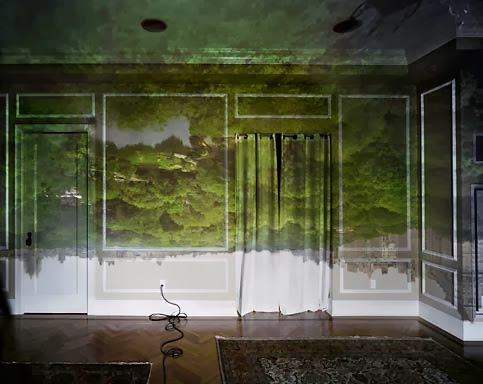
 View of Central Park Looking North-Summer, 2008

Blurry Upright Camera Obscura: Santa Maria della Salute with Scaffolding in Palazzo Bedroom, 2007

 View of the Brooklyn Bridge in Bedroom, 2009

The Pantheon in Hotel Albergo Del Sole al Pantheon, Room # 111, Rome, Italy, 2008 

 Santa Maria della Salute in Palazzo Bedroom, Venice, Italy, 2006
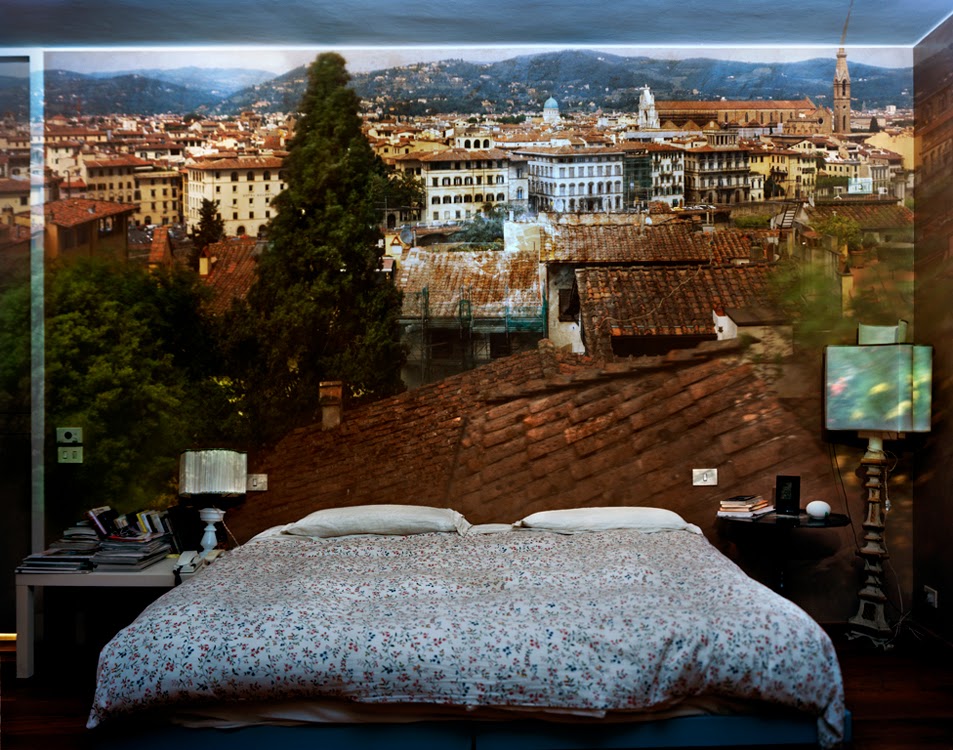
View of Florence Looking Northwest Inside Bedroom. Italy, 2009

So yesterday I briefly touched on early 3D technology, or the stereoscope. It uses our natural depth perception to its advantage and through two slightly different images creates a third image that our eye perceives has depth or three dimensions; height, width and depth. Now I'm moving on to another invention, the camera obscura or Latin for 'dark room'. If you go into a totally dark room and make a small hole to the bright outside the image from outside will appear on the opposite wall upside down! Why? Because for the simple fact that light travels in a straight line and when it bounces off of a bright object and passes through a small hole in a thin surface it will not scatter but cross and appear upside down.1 The earliest form of this was in the 5th century B.C. created by the Chinese philosopher Mo-Ti who created a 'locked treasure room' using a pinhole in a dark space. It was also used by Leonardo de Vinci, and as I mentioned earlier Vermeer. Since the perspective was preserved perfectly it was often used to aid in painting. It also was the precursor for the modern camera and the overhead projector we remember from school.
from Leonardo de Vinci's notebook2

With Morell's work I really enjoy the magical quality to the pieces. While the technology is old, it still never fails to impress at it's 'magic'. In some ways it reminds me of why we still go to theatres and enjoy being taken away. Why we hold onto our suspention of disbelief; we still have wonder. This innate sense of wonder coupled with the juxtoposition of the empty room; somewhat desolate or abandoned, like a hotel room far away from home coupled with the astounding images of color and life creates a true sense of awe and enjoyment at images we may have seen many times. Places that are famous but when recreated reignite my sense of joy in their beauty. 

From Morell on his own work:

"I made my first picture using camera obscura techniques in my darkened living room in 1991. In setting up a room to make this kind of photograph, I cover all windows with black plastic in order to achieve total darkness. Then, I cut a small hole in the material I use to cover the windows. This opening allows an inverted image of the view outside to flood onto the back walls of the room. Typically then I focused my large-format camera on the incoming image on the wall then make a camera exposure on film. In the beginning, exposures took from five to ten hours.
Over time, this project has taken me from my living room to all sorts of interiors around the world. One of the satisfactions I get from making this imagery comes from my seeing the weird and yet natural marriage of the inside and outside.
A few years ago, in order to push the visual potential of this process, I began to use color film and positioned a lens over the hole in the window plastic in order to add to the overall sharpness and brightness of the incoming image. Now, I often use a prism to make the projection come in right side up. I have also been able to shorten my exposures considerably thanks to digital technology, which in turn makes it possible to capture more momentary light. I love the increased sense of reality that the outdoor has in these new works .The marriage of the outside and the inside is now made up of more equal partners."


See more of Morell's work at http://www.abelardomorell.net/
1.http://brightbytes.com/cosite/what.html
2.http://www.lumen.nu/rekveld/wp/?p=352

Monday, 4 November 2013

Vermeer's Music


There was recently an exhibition on at the National Gallery called "Vermeer and Music: The Art of Love and Leisure" connecting the role of music in romantic relationships of the time to how musical instruments and musicians were placed in some of Vermeer's work. This combined two of my favourite things music and art, and with live music playing by the Academy of Ancient Music you could hardly tear me away from the exhibition. Music was an integral part of leisure time for the wealth, it was a sign of prestige and good breeding to be able to play several instruments. As a young lady, it was one of the few times you could be alone with a man and create music together. The placements of the players and instruments in the paintings are integral to understanding the undercurrents of the relationships between the participants. Added to this, to be able to hear music of the day added another layer of understanding and enjoyment to the viewing of the paintings.

In the above painting, "Young Woman Seated at a Virginal", she looks at the viewer in askance to join in her music this conclusion is aided by the Viola da Gamba (3) a symbolically masculine instrument as opposed to the virginal, associated with the female. It is unattended and at a difficult angle to paint, creating interaction and invitation with the viewer, something that Vermeer often does in his paintings with this instrument. This affair, between the lady and the viewer is interpreted as a pure form of love which is aided by the juxtaposition of the painting behind the lady, "The Procuress" (2), where a prostitute solicits her clients with her lute playing. Contrasting their profane love to the virginal often seen as a symbol for harmony and pure love. While the viola da gamba and the marbled virginal show exquisite detail, it is in the lady's hands (1) where Vermeer is far ahead of his time. He seems not to care for the careful detail of the fingers and hands as other artists of his time, but rather for the play of light and dark and how these wedges of colours come together to form the hand, he shows purely what is visible rather than the detail that would be impossible if this was a photograph. This almost photographic focus on the foreground and the blurred background has been speculated to show Vermeer's use of the camera obscura, or the precursor to the modern camera.

In "The Guitar Player" we again see this fascination with light and shadow, which to his contemporaries seemed unrefined, but fascinated early photographers. You can see in the hands of the guitar player (2), that flat patches of colour magically seem to come together to form the light playing on her fingers as they move on the neck of the guitar. The same is true of the pearls (1) where a band of grey followed by white highlights create the texture of the translucent pearls. The individual pearls are not painted in great detail but it is the two techniques that form their spherical and reflective nature. She looks outside the frame of the painting to another player? Listener? Creating intimacy and forms a relationship between the girl and the viewer. With her other hand (3) you can practically hear the echo of the guitar as Vermeer painted the strings in mid-vibration.

In the exhibition real instruments and music were shown alongside the paintings. There was even an eerily similar guitar to the one in "The Guitar Player" and this along side the music that played every hour the paintings seemed to come alive again with the echos of the love songs played in 17th century Delft.

Below you can hear some clips from the music performed by the Academy of Ancient Music at the National Gallery (video). Or check out the podcast.

1.painting details:
http://www.essentialvermeer.com/catalogue/lady_seated_at_a_virginal.html
http://www.essentialvermeer.com/catalogue/guitar_player.html
2.National Gallery: http://www.nationalgallery.org.uk/whats-on/exhibitions/vermeer-and-music
3. The Academy of Ancient Music:http://www.aam.co.uk/#/