Showing posts with label Projected Series. Show all posts

Wednesday, 27 November 2013

Artists that Inspire: Abelardo Morell

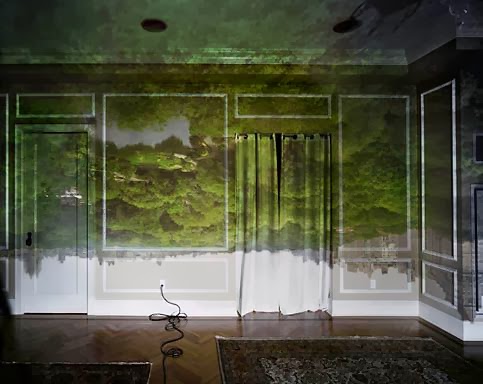
 View of Central Park Looking North-Summer, 2008

Blurry Upright Camera Obscura: Santa Maria della Salute with Scaffolding in Palazzo Bedroom, 2007

 View of the Brooklyn Bridge in Bedroom, 2009

The Pantheon in Hotel Albergo Del Sole al Pantheon, Room # 111, Rome, Italy, 2008 

 Santa Maria della Salute in Palazzo Bedroom, Venice, Italy, 2006
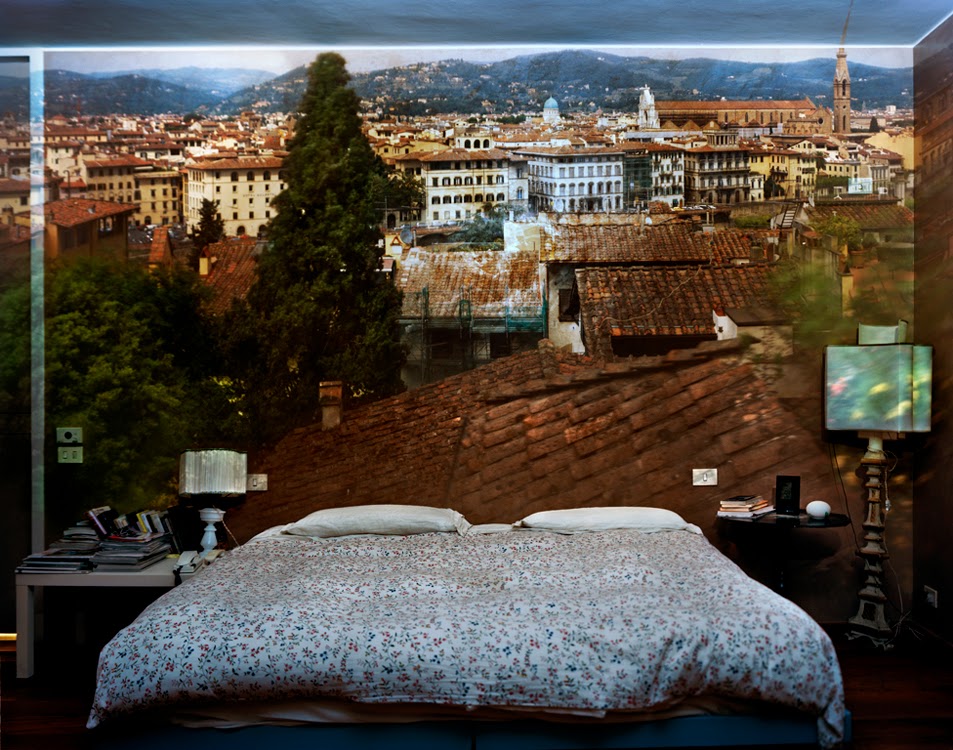
View of Florence Looking Northwest Inside Bedroom. Italy, 2009

So yesterday I briefly touched on early 3D technology, or the stereoscope. It uses our natural depth perception to its advantage and through two slightly different images creates a third image that our eye perceives has depth or three dimensions; height, width and depth. Now I'm moving on to another invention, the camera obscura or Latin for 'dark room'. If you go into a totally dark room and make a small hole to the bright outside the image from outside will appear on the opposite wall upside down! Why? Because for the simple fact that light travels in a straight line and when it bounces off of a bright object and passes through a small hole in a thin surface it will not scatter but cross and appear upside down.1 The earliest form of this was in the 5th century B.C. created by the Chinese philosopher Mo-Ti who created a 'locked treasure room' using a pinhole in a dark space. It was also used by Leonardo de Vinci, and as I mentioned earlier Vermeer. Since the perspective was preserved perfectly it was often used to aid in painting. It also was the precursor for the modern camera and the overhead projector we remember from school.
from Leonardo de Vinci's notebook2

With Morell's work I really enjoy the magical quality to the pieces. While the technology is old, it still never fails to impress at it's 'magic'. In some ways it reminds me of why we still go to theatres and enjoy being taken away. Why we hold onto our suspention of disbelief; we still have wonder. This innate sense of wonder coupled with the juxtoposition of the empty room; somewhat desolate or abandoned, like a hotel room far away from home coupled with the astounding images of color and life creates a true sense of awe and enjoyment at images we may have seen many times. Places that are famous but when recreated reignite my sense of joy in their beauty. 

From Morell on his own work:

"I made my first picture using camera obscura techniques in my darkened living room in 1991. In setting up a room to make this kind of photograph, I cover all windows with black plastic in order to achieve total darkness. Then, I cut a small hole in the material I use to cover the windows. This opening allows an inverted image of the view outside to flood onto the back walls of the room. Typically then I focused my large-format camera on the incoming image on the wall then make a camera exposure on film. In the beginning, exposures took from five to ten hours.
Over time, this project has taken me from my living room to all sorts of interiors around the world. One of the satisfactions I get from making this imagery comes from my seeing the weird and yet natural marriage of the inside and outside.
A few years ago, in order to push the visual potential of this process, I began to use color film and positioned a lens over the hole in the window plastic in order to add to the overall sharpness and brightness of the incoming image. Now, I often use a prism to make the projection come in right side up. I have also been able to shorten my exposures considerably thanks to digital technology, which in turn makes it possible to capture more momentary light. I love the increased sense of reality that the outdoor has in these new works .The marriage of the outside and the inside is now made up of more equal partners."


See more of Morell's work at http://www.abelardomorell.net/
1.http://brightbytes.com/cosite/what.html
2.http://www.lumen.nu/rekveld/wp/?p=352

Tuesday, 26 November 2013

Tuesday Toolbox: Stereoscope Lesson


Compass: " Ugh! It just makes me dizzy. How does it pop out at you like that?"

Pencil: "Well, I just don't believe that perspective!"

A stereoscope was an early medium for 3D technology. Whe the two seperate left and right eye images overlap with our binocular vision they form one image that seems to have depth as the horizontal position of the image seems to shift. This was an early form of home entertainment in the 1850s to the 1920s, especially for those who went on holiday around historical sites. Later this developed into the View-Master. Now we can go for the ultra-modern, the My3D app or 3D films. We are always trying to make every image hyper-real. For more information on the stereoscope go here.

The image in the stereoscope is "Farm in the Lades (House in the Garde)" by Etienne Theodore Rousseau at the Sterling and Francine Clark Art Institute.

- have you ever held out your pencil to figure out perspective?


drawing by: Chloe Cornell

Monday, 18 November 2013

"Inner Perspective"- In Depth


One summer a bunch of fellow students from various disciplines got together and created the "Dreams" exhibition at the Shoreditch Town Hall basement. A maze of small rooms, nooks and crannies with unexpected architectural Victorian details, ancient stoves and other relics of a complicated past. The rooms are dark and mysterious. My impression of this space is broadly coloured by my first visit during an Edgar Allan Poe exhibition which, as you can imagine, was rather haunted.

Our collective starting point was 'dreams' and any number of definitions could apply. And with so many different creative types coming together the results were broad and varied.

My idea sprang from the site, dark and enclosed. I wanted to juxtapose this atmosphere with a bright and open film, with shots of the outdoors and travel. Though I wanted these scenes to be disjointed and dreamlike with no real characters, only a variety of images looped and confused, like real dreams.

The character of the dreamer came next, the physical manifestation of the dreamer's portrayal of herself is honest and without filters. She is trapped in the room of her mind where the audience can come in and view her character stuck in this endless loop of dreams. Her reaction's are very visceral, almost childlike in the clear emotive responses, which are just as disjointed as the dream itself. I ended up playing this character, who else would do this for a week on the half hour for free? I also reacted to the audience, weaving around them and reacting to their intrusion into the room of my mind in order to bring them into the dream world.

The set was minimal, a single wooden chair with plants and dirt under the chair, an echo of the dream manifesting in her 'mind' space. There was a light under the chair to bring focus and gravitas to its placement and to illuminate the vegetation. This vegetation, both real and fake, also showed up along the edging of the door, the exit to the real world. My costume was a dress created from various cream and white fabrics pieced together and pleated paper, which slowly disintegrates, on the bodice. The colour palette of the film and the flower in my hair links to the vegetation in the room and connects both to the film which provides a contrast to the stark dark atmosphere of the basement. A comment on the reality vs. the dream world.

The film itself was made up of a very bright nature/ playful images vs the city, shown through a journey in the tube/arcade. This echoing my readings of Walter Benjamin's ideas of the wandering pedestrian. The approach to the chair in the beginning of the film echoes the girl already sitting in the same chair in the room. Real life events are echoed in the dream world but skewed. Another image is my 'dream' self disappearing from the screen and the real girl looks wildly around the room, logic has no place in this dream world. The childlike aspects are repeated with the swings and slides which are welcomed with joy and playfulness in contrast to the packed tube which is reacted to with fear. I tried to bridge the gap between the 'dream' world and the 'dreamer' with direct reactions and even using the projected image as a 'set'. Like when the train arrived I joined the queue on the platform as we waited for the train.

With this approach to the set as well as the interaction with the audience I hoped to bring them into my dream wold and to have them become a participant rather than a passive viewer, something they naturally resisted and thus seemed to prefer to watch the film. This project later led to my work on Martin Crimp. See here.
A video of the project here.