Showing posts with label camera. Show all posts

Wednesday, 27 November 2013

Artists that Inspire: Abelardo Morell

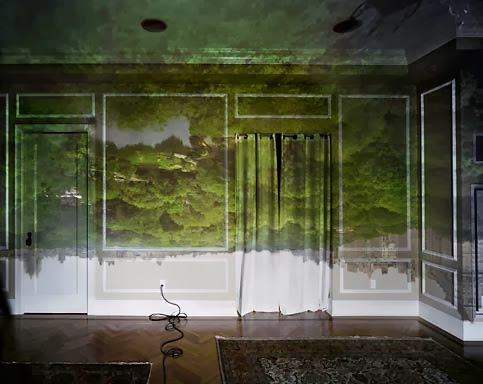
 View of Central Park Looking North-Summer, 2008

Blurry Upright Camera Obscura: Santa Maria della Salute with Scaffolding in Palazzo Bedroom, 2007

 View of the Brooklyn Bridge in Bedroom, 2009

The Pantheon in Hotel Albergo Del Sole al Pantheon, Room # 111, Rome, Italy, 2008 

 Santa Maria della Salute in Palazzo Bedroom, Venice, Italy, 2006
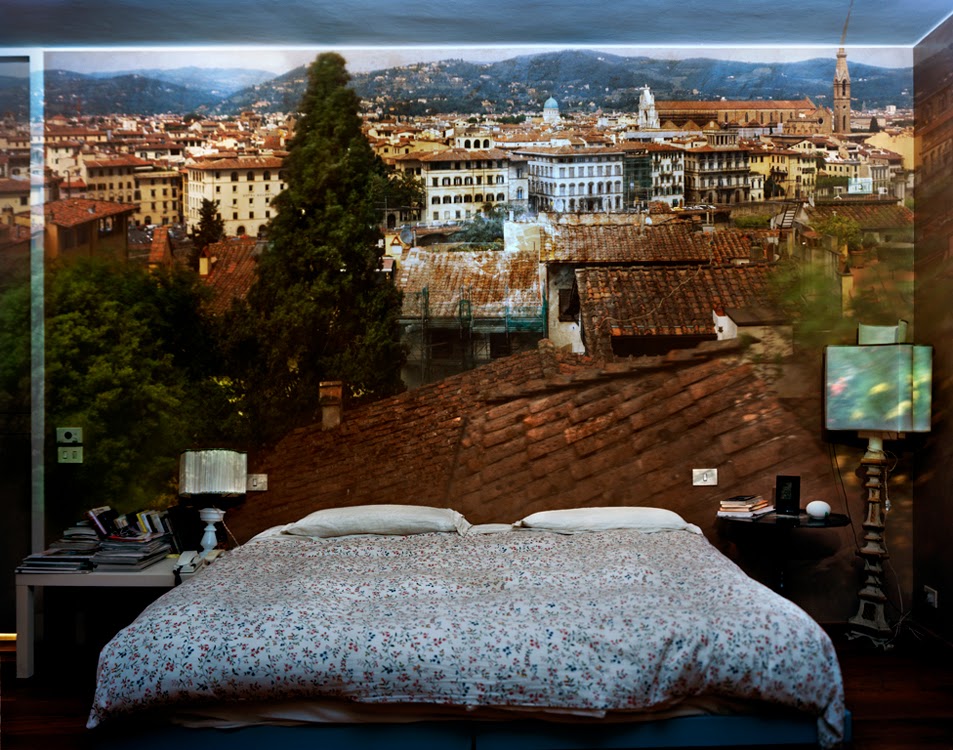
View of Florence Looking Northwest Inside Bedroom. Italy, 2009

So yesterday I briefly touched on early 3D technology, or the stereoscope. It uses our natural depth perception to its advantage and through two slightly different images creates a third image that our eye perceives has depth or three dimensions; height, width and depth. Now I'm moving on to another invention, the camera obscura or Latin for 'dark room'. If you go into a totally dark room and make a small hole to the bright outside the image from outside will appear on the opposite wall upside down! Why? Because for the simple fact that light travels in a straight line and when it bounces off of a bright object and passes through a small hole in a thin surface it will not scatter but cross and appear upside down.1 The earliest form of this was in the 5th century B.C. created by the Chinese philosopher Mo-Ti who created a 'locked treasure room' using a pinhole in a dark space. It was also used by Leonardo de Vinci, and as I mentioned earlier Vermeer. Since the perspective was preserved perfectly it was often used to aid in painting. It also was the precursor for the modern camera and the overhead projector we remember from school.
from Leonardo de Vinci's notebook2

With Morell's work I really enjoy the magical quality to the pieces. While the technology is old, it still never fails to impress at it's 'magic'. In some ways it reminds me of why we still go to theatres and enjoy being taken away. Why we hold onto our suspention of disbelief; we still have wonder. This innate sense of wonder coupled with the juxtoposition of the empty room; somewhat desolate or abandoned, like a hotel room far away from home coupled with the astounding images of color and life creates a true sense of awe and enjoyment at images we may have seen many times. Places that are famous but when recreated reignite my sense of joy in their beauty. 

From Morell on his own work:

"I made my first picture using camera obscura techniques in my darkened living room in 1991. In setting up a room to make this kind of photograph, I cover all windows with black plastic in order to achieve total darkness. Then, I cut a small hole in the material I use to cover the windows. This opening allows an inverted image of the view outside to flood onto the back walls of the room. Typically then I focused my large-format camera on the incoming image on the wall then make a camera exposure on film. In the beginning, exposures took from five to ten hours.
Over time, this project has taken me from my living room to all sorts of interiors around the world. One of the satisfactions I get from making this imagery comes from my seeing the weird and yet natural marriage of the inside and outside.
A few years ago, in order to push the visual potential of this process, I began to use color film and positioned a lens over the hole in the window plastic in order to add to the overall sharpness and brightness of the incoming image. Now, I often use a prism to make the projection come in right side up. I have also been able to shorten my exposures considerably thanks to digital technology, which in turn makes it possible to capture more momentary light. I love the increased sense of reality that the outdoor has in these new works .The marriage of the outside and the inside is now made up of more equal partners."


See more of Morell's work at http://www.abelardomorell.net/
1.http://brightbytes.com/cosite/what.html
2.http://www.lumen.nu/rekveld/wp/?p=352

Tuesday, 5 November 2013

Tuesday Toolbox


Paintbrush: " But where is the Aura? 
Camera: " What do you mean, Aura? My gaze is not indifferent!"

photograph sketch based on above sculpture


Aura: "the authenticity of a thing is the essence of all that is transmissible from its beginning, ranging from its substantive duration to its testimony to the history which it has experienced” (221).

 “we define the aura of the later as the unique phenomenon of a distance, however close it may be. If, while resting on a summer afternoon, you follow with your eyes a mountain range on the horizon or a branch which casts its shadow over you, you experience the aura of those mountains, of that branch” (222-3) from The Work of Art in the Age of Mechanical Reproduction


Walter Benjamin: Illuminations: Essays and Reflections. Ed. Hannah Arendt. Trans. Harry Zohn. New York: Schocken Books, 1968.
Photo:http://www.pinterest.com/pin/31243791136764638/
source:http://modernism.research.yale.edu/wiki/index.php/The_Work_of_Art_in_the_Age_of_Mechanical_Reproduction


Thursday, 11 April 2013

Reviving the Lens


“I’m an eye. A mechanical eye. I, the machine, show you a world the way only I can see it. I free myself for today and forever from human immobility. I’m in constant movement. I approach and pull away from objects. I creep under them. I move alongside a running horse’s mouth. I fall and rise with the falling and rising of bodies. This is I, the machine, maneuvering in the chaotic movements, recording one movement after another in the most complex combinations. “

“Freed from the boundaries of time and space, I co-ordinate and all points of the universe, wherever I want them to be. My way leads towards the creation of a fresh perception of the world. Thus I explain in a new way the world unknown to you”
-Dziga Vertov, 1923 p.10 Berger
on the film camera

We are now very used to whipping out our phones or cameras to take a photo or shoot a film. There is little effort involved and we are quite at home with recording our daily lives almost to the point of becoming the spectator rather than the lead in our own lives. Of course filming and photography were not always so simple. At the beginning of the last century it was new, laborious, expensive and time consuming. It was an event. 


Dziga Vertov's "The Man with the Movie Camera" 1929

Like the art movements of Cubism and Surrealism, the movie camera changed the focus of an image, forcing the viewer to look at a larger number of stimuli that quickly move the spectator through the narrative as opposed to painting or sculpture, where the meaning can be pondered at a leisurely pace. This forces the fragmentation of the subject rather than the alienation of the subject. Filmmaking, which started as a reflective approach to narrative, soon gave way to a highly subjective, fragmented use in media.


We are now so used to these mediums that we take it for granted. At the same time we still yearn for the effects of the past, though now it is in a handy app. The artists below have found ways to appreciate and continue to pay homage to the old methods of photography. 


David Lo, a street photographer, gives a tutorial on how to digitise a vintage camera. With this new configuration, using a digital camera on the back an old camera a new hybrid is created. The vintage camera used must have bellows or an adjustable lens to work in concert with the apparatus of the digital lens. The experience of shooting with this modified camera, the weight, the focusing, light leakage all lead to an overall different experience than what you would get when using a retro process on your phone. While some might gasp in horror at defacing an old camera, I enjoy the idea of giving it another life and using it once again for the purpose for which it was made. You can do this or leave it on a shelf gathering dust. And while some rarer cameras I would leave as is, for a retro/art/photography enthusiast this is a great way to give an old camera a new lease on life and to appreciate the process of taking a photo while still keeping the instant nature and plethora of images that come with the digital age. 

see the full tutorial at: http://petapixel.com/2013/03/27/modding-a-vintage-camera-for-digital-use/


These wondrous art pieces above were created by Guangzhou Art Academy student Hu Shaoming over a period of four months for the exhibition Reconnecting Time. He dissembled two cameras and rebuilt them with a zipper to show the "magic" of each device so we can clearly see how the "great industrial discoveries of humanity" work.

Again, some people may be horrified that he destroyed a piece of history. But again, you cannot really get film to make it work, and most people just collect these cameras for display. So instead of letting them sit there static, Hu Shaoming has created a work of art that exposes the mystery and lets us appreciate the delicate inner workings of the camera, a land breaking invention that allowed us to perfectly record our lives and freed painters from being merely realistic recorders of history.


Instead with the advent of photography and film this anchor of reality was no longer needed in the world and resulted into what we now know as modern art.